
Theater Reviews
The Merry Wives of Windsor RSC July 2024
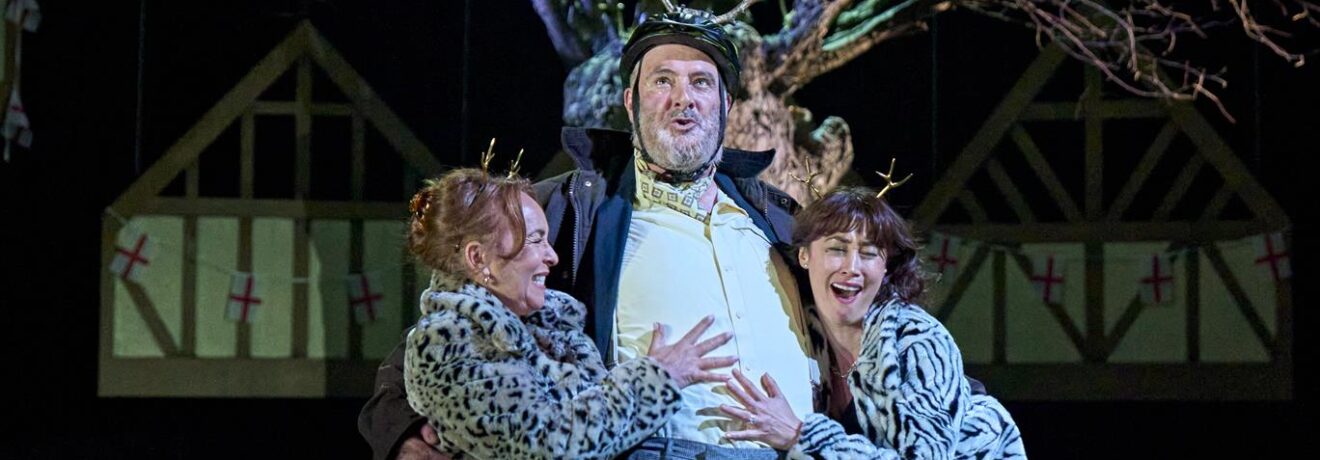
At the RSC, Blanche McIntyre’s The Merry Wives of Windsor has plenty of boisterous physical comedy and audience-pleasing shout-outs to current events and pop culture. The scenes with the wives move delightfully at a breakneck pace, and speed works well for this play. It prevents one from trying to disentangle the logic of the side schemes, especially those involving the Host (a jolly Emily Houghton) and the likable pair of party animals Pistol and Nym. Omar Bynon’s enthusiastic smile sweetens what could come across as a lager lout–Pistol’s high-flown language somehow works as modern comic braggadocio–and Yasemin Özdemir’s Nym sports an England soccer shirt, to complement the tiny England flags adorning the Garter Inn (a common sight in the UK this summer, as England vied for the UEFA cup). The plot involving the Germans and the Hostess’s horses seldom makes it to the stage these days, but here the addition of an accordion and Oktoberfest hats on Pistol and Nym create a diverting comic dash. Jokes at the expense of the French are clearly still fair game, as Jason Thorpe’s Dr. Caius snaps, “Let-a me speak a word with your arse” (3.1.60).[1] Designer Robert Innes Hopkins’ note-perfect suburbia (there’s even a plastic carrier bag fluttering in the branches of Herne’s Oak) slyly comments on gate-keeping in modern Britain and elsewhere; the set is peppered with rule-bound signage of “Keep off the grass” and “Parking for residents only”, which the riotous followers of Falstaff kick over in cheerful anarchy.
The production has an unusual number of serious dramatic moments, perhaps in an attempt to give the jealousy and sexual harassment more weight for an audience sensitive to #MeToo. The wives aren’t quite ready to forgive Ford after the buck-basket scene, coldly turning their backs on his chastened invitation to dinner. Later, Ford sobbingly apologizes for doubting his wife, and in a number of scenes, Richard Goulding’s Ford veers close to tragedy, as if rehearsing for playing Leontes. Though Page (the ebullient Wil Johnson) scoffs at Ford’s fears, Malcolm Rippeth’s light design pushes the scene toward drama by dimming the lights as Ford is left alone to stew in his doubts. The text seems to resist some of these serious choices, however; for example, the gravity of Ford’s later soliloquy, “This it is to be married,” turns quickly to bathos as he continues, “to have … linen, … and … buck-baskets.” (3.5.96-97, actor’s pauses and emphases) Occasionally, though, Goulding’s almost despairing tone and resulting stately vocal delivery take the audience out of the world of comedy–which, given their laughter on the night I saw the production, was where they preferred to be.
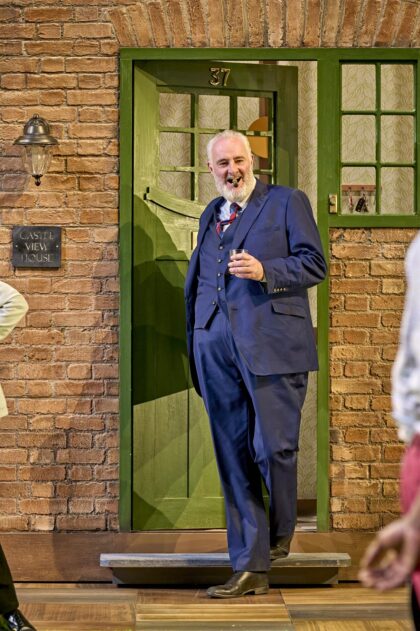
Hodgkinson’s Falstaff seems to aim for a characterization that conveys how Falstaff sees himself–the “goodly portly man” of Henry IV part 1–rather than the harried and impecunious butt of practical jokes. His vocal delivery is generally slow and pompous, like a long-winded politician enjoying the sound of his own voice; this works in some scenes, but at other moments a brisker pace would create more variety and highlight the character’s wit. Hodgkinson borrows some mannerisms from his portrayal of Antonio in the RSC’s 2019 Venice Preserv’d–commanding, icky, and ripe for taking down by a strong woman. From his first scene, as he blocks the doorway to the Page house and smiles suggestively when the women have to sidle past him, his sexual harassment tactics are clear and all-too-familiar. In a later scene, as Mistress Ford neatly parries his advances, he tumbles off the couch, swiftly turning the pratfall into a comedic seductive pose. He never seems to lose control of the situation–even being thrown into the river seems little more than a minor annoyance. Perhaps Falstaff’s punishments will acquire a sharper edge as the production run continues.
As Mistress Page, Samantha Spiro is the star of the show–she’s the only named actor in the publicity material, and her frenetic physicality and roaring comedic vocal tone propel the energy of her every scene. I was reminded of her excellent Kate in the Globe’s 2012 Taming of the Shrew: this performance feels like a mature progression of that character, one who has learned how to be happy, reveling in her status as a trusted wife and community leader. Her brief soliloquy, which ends, “Wives may be merry, and yet honest too,” (4.2.74) earned a round of applause, punctuated by a few cheers of solidarity from female audience members. As the not-so-desperate housewives, Spiro and Siubhan Harrison are an excellent pairing, giving mutual emotional support and cracking each other up in their zany plots against Falstaff. In the buck-basket scene, they both look as though they are having a ball in the scenes of trickery. As Falstaff hides behind a pair of curtains (with his belly sticking out), Mistress Page gallops around the Fords’ living room, coming to rest beside the enormous laundry hamper and proclaiming, “Look, here is a basket!” (3.3.86) in the same machine-gun delivery as the rest of her short, breathless sentences in the scene. When Falstaff pitches himself head-first into the basket, and Robert and John heroically struggle to move it (Riess Fennell and David Partridge make strong comic moments out of their brief appearances), the women make themselves gin-and-tonics and grab a moment of relaxation before the hectic pace resumes. Realizing the toll that Ford’s unfounded jealousy is taking on her friend, Mistress Page gives her a quiet moment of commiseration before gently urging, “Come hither; let’s consult together against this greasy knight.” (2.1.74, phrases transposed from the text). Mistress Ford returns the favor when her friend is close to tears at losing her daughter in the final scene, by delivering one of Ford’s lines: “Stand not amazed; here is no remedy:/ In love the heavens themselves do guide the state.” McIntyre wisely cuts the rest of the speech– “Money buys lands, and wives are sold by fate.” (5.5.191-2)–as it would have jarred with the prevailing tone of the final scene. Such moments are judiciously placed, and create a real sense of female friendship.
Modern dress allows designer Hopkins to comment on the various types that populate the play. Falstaff’s blue suit and striped club tie recall powerful Tory MPs (in fact, Hodgkinson’s Falstaff looks rather too point-devise for one in his straitened circumstances, unless he’s been spending everything on his wardrobe), while Justice Shallow (John Dougall) is every inch the country conservative, in his tweeds and Barbour jacket. The wives wear spiffy yoga gear and a range of comfortable fashions, and given the amount of running they do in the play, they must be grateful for Hopkins putting them in stylish sneakers for much of the action. Like a high school theatre director, Sir Hugh (a sprightly Ian Hughes) wears an Into the Woods t-shirt as he energetically coaches the youth of Windsor for their fairy dance, and Mistress Quickly’s house cleaning smock is like an establishing shot in a TV show: the lively Shazia Nicholls never wears it after her first scene. Prancing around in high heels and tight pencil skirts, flicking back her long hair, and giving the glad eye to Pistol, she frequently looks as if she is off to a nightclub, rather than any gainful employment.
The climactic scene at Herne’s Oak is here a fast-paced mix of emotional tones. It starts with a frisson of sexual danger–the wives wear slinky black and sparkly antler tiaras. It then shifts to physical danger, as the “fairies” enter in black hoodies and menacing glow-in-the-dark masks; and finally segues into a musical theatre number with composer Tim Sutton’s arrangement of the text’s song, “Fie on sinful fantasy”. Page’s anger at Slender for eloping with the wrong person is long and startlingly loud, especially from such an easygoing character. As Anne Page and Fenton, Tara Tijani and John Leader are a hip and attractive couple, though the marriage plot does present an incongruous element in a production set in modern Britain, as Anne’s otherwise liberal parents pressure her to marry for money and position. The tormenting of Falstaff goes on a bit longer than necessary; despite Falstaff’s many transgressions, his “I am…dejected” (5.5.138) draws a sympathetic murmur from the audience. All the couples exit, leaving Falstaff alone; gazing around at the audience, he shrugs and follows them off as the lights dim. The text leaves little room for a true change of heart for Falstaff, and Hodgkinson’s equivocal final moments suggest that the character has learned little about respect for women. However, Ingrid MacKinnon’s choreography lifts this somewhat muted ending with a high-energy curtain-call dance that welcomes Falstaff back into the community.
Not all of the 400-year-old comedy is ageless. There was nervous laughter at some of Falstaff’s fat jokes–especially those delivered by himself–as if the audience was unsure whether to participate in what many might regard as fat-shaming. The production doesn’t seem to take any stance on it–none of the fat jokes were removed (though Hodginkson’s padding was not as extreme as many past productions have been). The comedy of Falstaff’s disguise as the woman of Brentford–high heels, tights, a flowered dress and heavily-veiled hat, as if ready for a garden-party–relies on his awkwardness with high heels. Surprisingly, back in the safety of his room at the Garter Inn, he does not immediately remove his shoes, but rather tiptoes around like Jack Lemmon in Some Like it Hot. Uncomfortably, Sir Hugh’s comment, “I like not a woman with a beard,” got a surprisingly big laugh, despite the production’s openness to finding LGBTQ+ moments elsewhere. For example, the confusions arising from Anne Page’s multiple suitors result in a sweet same-sex coupling of Slender and Robin, who had registered his interest in Slender in an earlier scene. As the latter, Tadeo Martinez has a dozy charm, delivering his messages with a relaxed grin, and his affectionate pairing with Patrick Walshe McBride’s upper-class twit Slender earned warm chuckles from the audience. In a Stratford-upon-Avon festooned with Pride flags, Sir Hugh’s cheap crack could easily have been excised.
Merry Wives is one of Shakespeare’s funniest (and most underrated) plays, and McIntyre’s production scores a summer hit for the RSC.
[1] All line references come from William Shakespeare Complete Works, eds. Jonathan Bate and Eric Rasmussen. Modern Library, New York, 2007.