
Theater Reviews
Coriolanus at The National Theatre
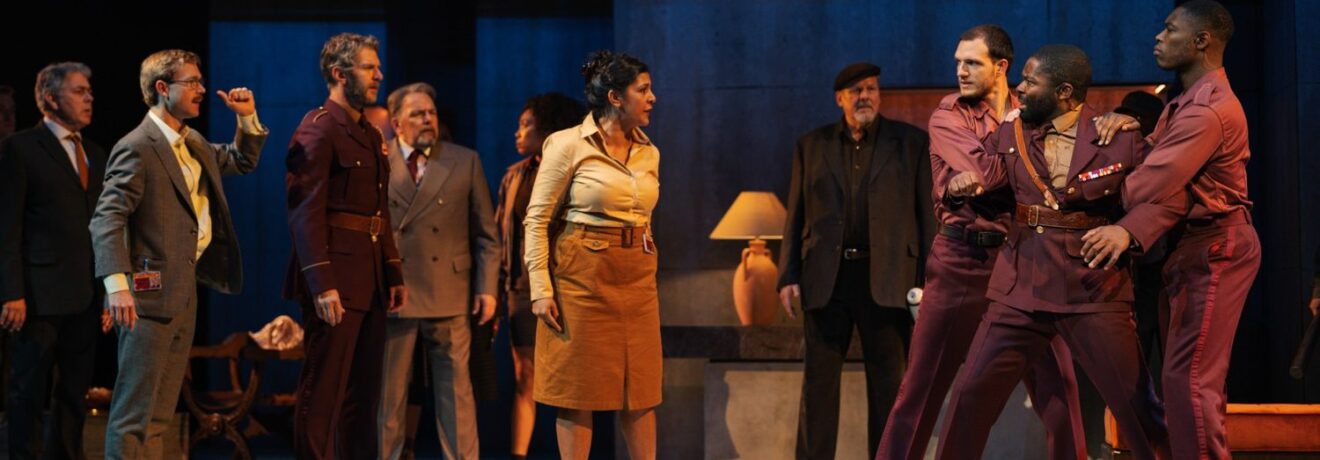
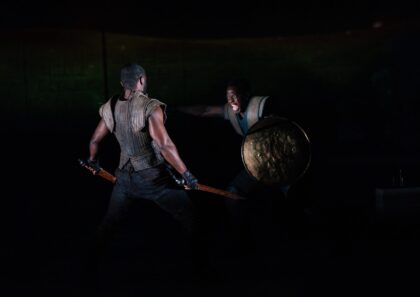
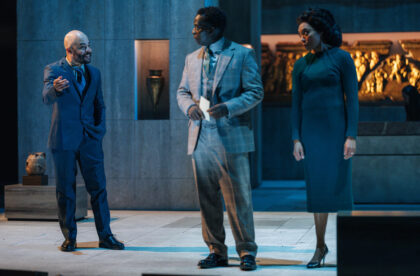
Seen on 28 September 2024, the set of Coriolanus (directed by Lyndsey Turner) was visible on its uncurtained stage when I arrived at the National Theatre, and my immediate response was, “Oh, it’s taking place in the British Museum.” Of course, the assemblage of statues and sarcophagi turned out to be flexible enough to suit a variety of imagined locations, but their presence, juxtaposed with modern actors interpreting Jacobean Romans, was the most suggestive aspect of Lyndsey Turner’s production. By contrast, the heavily cut text was a rapid retelling, almost more documentary than drama (hence the video screens), of the hero’s trajectory from Caius Martius to Coriolanus, from war hero to politician to pariah to his ambiguous ending.
The play, though it is intensely focused on this hero, gives him very little opportunity to suggest much capacity for any emotions apart from anger and contempt. It thus requires the actor to supply what is missing from the writing. David Oyewolo, as Caius Martius, displayed the physical power on which the hero’s reputation depends and was also an impressive presence when he simply stood with the louring stillness of someone who expects to be obeyed as a matter of course. Though the other characterizations didn’t have a great deal of nuance, the interpretation as a whole was balanced: Menenius (Peter Forbes) and the tribunes (Stephanie Street and Jordan Metcalfe) were more evenly matched than usual, and the plebeians were not caricatured. There was a class struggle, but it was not about corn. And there was no laugh (should there be one?) on the line, “though we willingly consented to his banishment, yet it was against our will” (4.6.153-4). The refusal of caricature, indeed, meant that there was not a great deal of comedy in the production.
Traditionally, directors have made the most of the opportunities for pageantry in Coriolanus to compensate for the lack of other kinds of interest. Lyndsey Turner did not hold up the story with this kind of spectacle. Most notably, once Coriolanus had capitulated to his mother, the production rushed on to his inevitable death, removing the elaborate procession in which Volumnia and the other women return to a Rome that rejoices in having been spared. As a result, Volumnia’s role felt incomplete to me. This was not the fault of Pamela Nomvete, who portrayed a credible “suffocating mother,” but I missed what, in various other productions, I have seen her demonstrate: a terrifying pride at having lived up to Roman values; or silent grief for what she knows will happen to her son; or determination to make her grandson, young Martius, into a still more inhuman warrior than his father. Unless I missed it, there seemed no way of knowing how she felt at the end of their momentous confrontation. But then, Shakespeare has not given her any lines, and that may be the point.
This filmic cutting and prioritizing of action, typical of many recent Shakespeare productions, made me feel, as often, that knowing the play was probably a disqualification for reviewing it. I could understand the cutting of episodes (like the encounter of Adrian and Nicanor in 4.3) that reinforce the general cynicism of the play but divert from the onward thrust of the main action. I could also understand why lines were moved from one speaker to another, to give small-part actors a bit more to do and to make female characters more visible. But I was puzzled by the transfer to Cominius of a speech that seems eminently characteristic of Martius — “Where is the enemy? Are you lords o’th’ field?/ If not, why cease you until you are?” (1.5.47-8). If it was meant to improve Cominius’s role, it did not succeed. The Roman patricians, apart from Menenius, remained indistinguishable.
The pay-off for the play’s museum setting came in the final moments, as we saw Coriolanus’s son, now a modern schoolboy visiting the British Museum, is looking at a statue of the war hero. Once described as ‘the rock, the oak, not to be wind-shaken’ (5.2.110), he has now been transformed into a work of art that is still more hard and rigid. These apparently ideal forms had once been fallible human beings, and they had not all been as white as the marble in the museum. The effect was brilliant – and it made a more interesting point than the play itself had been able to convey.