
Book Reviews
Review of Sujata Ivengar’s Shakespeare and Adaptation Theory
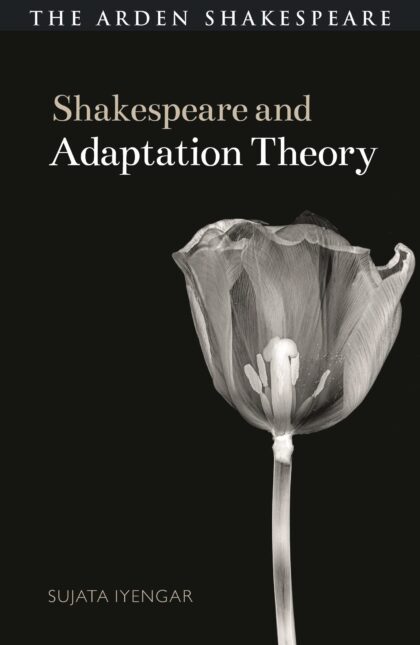
Shakespeare and Adaptation Theory (Bloomsbury 2023) is a new addition to the already substantial and well-established Arden Shakespeare and Theory series, overseen by series editor Evelyn Gajowski. The new volume takes its place alongside focused studies of Shakespeare and economics, psychoanalysis, ecocriticism, ecofeminism, materialist criticism, feminist, queer, and posthumanist theories, among other critical practices and approaches, by all leading theorists in each respective field or competency.
Like those other volumes, this one puts theory at the fore, organizing each of its seven chapters around the introduction and discussion of a particular style or type of adaptation or appropriation and its theoretical underpinnings. Each chapter then considers selected adaptations of a single play in light of what that particular approach, or those inter-connected approaches, can tell us about the nature of influence, creativity, fidelity, fandom, bodies and disembodied space, ability and disability, imagination, social or political engagement, cultural capital, and so on. As such, the general tenor of the book leans toward the abstract, nuanced, and sometimes even ethereal, generally consistent with the series’ goal of providing what the series editor calls “reflection and analysis” of the “theoretical ferment” that has defined and enlivened Shakespeare studies for several decades and caused a “seismic shift” in literary studies more broadly (ix-x). As I discuss below, while admirable in its own right, this goal of unpacking the dense work of contemporary theorists sometimes does not always play altogether well with the typical objectives of an…
Please login or subscribe to continue reading.
Please subscribe to The Shakespeare Newsletter to continue reading.
Subscribe Now